Wheelchairs + Tennis = Life Narratives #13 The Tournament That Created A Community

12417787_974999682619992_6810645628919105728_n

The “Wheel It Forward” Tournament

The clinic’s turnout convinced Jim and Alan that there was a real need for a physical outlet for persons with disabilities. Putting on a tournament seemed like the next logical but ambitious step. Since Brian was completely sold on the sport—he bought his own sports wheelchair, which handled “like a Porsche”—in December 2013 they sent him to the Wichita tournament as an observer. There Brian witnessed something else that deep down he truly wanted and needed: camaraderie, collegiality, and the opportunity to network with other athletes.

After observing in Wichita, Brian played in the tournament in Lincoln in August, 2014 and a few months later in Wichita. He briefed Jim and Alan on how those tournaments were run, and became the goodwill ambassador for the Kansas City tourney.

Having been briefed by Brian, Jim, Alan and other volunteers went to work on gathering the sponsors needed to underwrite their event. Jason Grubb, the owner and general manager of the six-court indoor Northland Racquet Club, generously donated the courts for the tournament. Over a dozen other sponsors and donors in the KC community kicked in thousands of dollars.

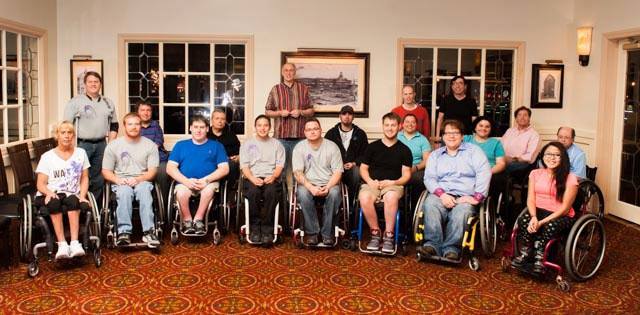
On Friday morning, April 10, 2015, with donuts, coffee, water, bananas, and other treats (no M&Ms or KitKats—sorry, Jim) spread out on tables in a small reception area, Alan welcomed eighteen inspired athletes to the First Annual “Wheel It Forward” Wheelchair Tennis Tournament. During the three days of the tournament the participants, no matter the skill level, played as worthy athletes, not victims of bad luck or fate. Jim made sure each of us understood that.

Pushing Through the Dark Space

Brian had finally come out of the shadows he had been in since the trauma of his accident. “I’m back in the game.” That he was.

Today, Brian’s life narrative is enriched and sustained by the broader narrative of the wheelchair tennis community. You see, the Wheel It Forward tournament was not just a competition where athletes won or lost matches. It created a space for the celebration of life. Brian says, “The saying, ‘We’re all in this together’ is never more true than in the wheelchair tennis community. We share collective community. When you don’t show up at a tournament, people notice, people care.”

Although Brian’s will power helped him reach his new space, he didn’t do it alone. Many other persons with their own life’s narratives guided Brian to the door between the two spaces—his family, friends, doctors, nurses, and therapists.

But there were two key life narratives that came together with Brian’s to wheel him forward via a tennis ball flying over a net in a tennis club in Kansas City. One was that of Alan Klaus, whose narrative as an adult began with a play on a high school football field in Beatrice, Nebraska.  The other was that of Jim Pfeffer, whose narrative began in Manitowoc, Wisconsin as he watched his high school tennis team practice while he crunched on candy. Whether it was the candy or surviving the Ice Bowl, Jim was at the heart of the collective space inhabited by the individual narratives of this story. Alan told me, “It would be very accurate to say that without Jim there would be no Wheel It Forward. Someone once told me that they would be afraid to tell Jim they wanted to play tennis on the moon because by the next week he would have the rocket ship booked!”

******

My game had improved since the Cajun Classic. I was more mobile and had a stronger stroke. I won one game—one game, not a set—in a round robin against three other quads: Taylor Graham, a young man from Lincoln who was in a motorcycle accident, Grady Landrum, a veteran player from Wichita who got smashed up in a car accident years ago, and Nick Taylor. I had no chance against Grady and Nick. Grady had perfected a sliced serve that I couldn’t handle, and Nick  . . . well, he had pity on me. I played some good balls against Taylor. Both of us were still getting use to using our quad-limited bodies to play the game effectively. I had to bow out of the second set because I developed severe pain in my taped-up hand. No, I wasn’t faking it!

The best part of the tournament was when Nick came over to me after my match against him and showed me how to effectively pivot to play a forehand. Most players have a stronger forehand than backhand. So when able-bodied players get a chance they will quickly shuffle into the forehand position. To mimic this in a wheelchair, you have to push yourself away from the ball and then turn into it. Nick got behind me with his motorized chair and pushed my chair through the maneuver. Nick Taylor touched my chair! I’m never going to wash it!
Wheelchairs + Tennis = Life Narratives #12 Finding the Roadrunner

Here’s the next excerpt from chapter three of my book about how a wheelchair tennis tournament came into being. But that’s the superficial story. More compelling is the subtext about how the individual narratives of Alan and Jim connected to create a broader narrative that would save Brian from falling irretrievably into the abyss.

Alan and Jim Link Up

After joining the Northland Racquet Club, Alan and Jim became good friends, the friendship nurtured in part by club-sponsored trips they took together. It wasn’t long before the duo became leaders of a group at the club that developed a tradition of holding yearly fundraisers for various causes, ranging from assistance for the victims of the earthquake in Haiti to support for the Global Orphan Project. It quickly became apparent to Alan that Jim was “loved and respected by everyone and known by all.” He had a way of making those around him feel important and valuable, a trait that would earn Jim a place in the Heart of America Tennis Hall of Fame.

Brainstorming Leads to a Wheelchair Tennis Clinic

At the beginning of 2013, the group started brainstorming on what project they would support for that year. One of the group’s members suggested doing something to support wheelchair tennis, noting that the USTA wanted to support and grow the sport.   Great! So . . . now what? Hey, how about a documentary about wheelchair tennis! It could be filled with so many compelling stories! Yeah, that’s the ticket! Not. They couldn’t find donors to foot the bill. Okay, let’s see . . . how about . . . some sort of wheelchair tennis event, like a clinic! Yes, that’s it! Awesome! Uh . . . well . . . how exactly . . . Don’t you need people to attend the clinic? And how do we find sports wheelchairs? They’re not exactly cheap.

Recruiting Nick Taylor

As to the first question, they contacted Nick Taylor in Wichita. Nick’s life direction was first decided in his mother’s womb, when he was born with arthrogryposis, a congenital condition that results in limbs being permanently fixed in a way that restricts movement, in Nick’s case pretty severely.  But check this out: He just happens to be one of the highest ranked quad players nationally and globally. And he plays in a motorized wheelchair. How sick is that! A tireless promoter of wheelchair tennis, Nick said he would love to attend the clinic to help draw participants. But he told the Northland group not to worry too much about the numbers. The clinic would be a success if only one or two players showed up. As to the second question, the group received a grant to buy a couple of sports wheelchairs.

Finding the Roadrunner

The first potential participant they thought of was Brian, the roadrunner. But where was he? Two weeks before the clinic, Jim tried calling Brian using the number he had used years earlier when Brian participated in the “hit and run” clinic. Brian didn’t answer. Jim left a message, “If this is you, Brian, we want you to let you know that we’re putting on a tennis clinic.”

Brian didn’t return the call. After the accident, he dropped off the tennis radar screen. It was as if he moved away from Kansas City. He lived life in the shadows, even avoiding reflections of himself in a wheelchair as he rolled past store windows. He steered clear of large crowds because he felt nobody could see him. He was invisible. And even if he wasn’t, people had to look down at him to talk. Were they thinking the same thing of him that before May 31st, 2002 he had thought of people in wheelchairs? Pity? Dismissive of him as a full human being? Brian actually ran into Jim a few years before the clinic. The instant Jim saw Brian, the roadrunner, in a wheelchair, a great wave of shock and sadness washed over him. Brian explained the accident to Jim and said he had no reason to go to Northland because he had become paralyzed from the waist down.

But Brian eventually did decide to attend the clinic, if only out of respect for Jim. They held it in April, 2013. Fifteen people attended. The participants’ physical challenges varied from birth conditions, to accidents, to persons who had contracted a disease. Nick Taylor brought inspiration and energy to the clinic, telling the participants that they would miss the ball a lot but that’s how most experienced players started.  Jim’s challenge as a coach was to keep the participants engaged, some of whom had never played the sport, whether in a wheelchair or on their legs like Brian. Jim had the newbies stationed just two feet away from the net. Just as Nick had predicted, they missed a lot.

Brian was hesitant to play, wanting to avoid looking like a “spastic.” Then he hit the tennis ball with the racquet’s sweet spot. The ball sailed over the net. And as Jim said of all the players in the clinic who did the same thing for the first time, “it was like they had just won Wimbledon.”


Wheelchairs + Tennis = Life Narratives #11 Jim Pfeffer: The Tennis Pro Who Loved KitKat

17362767_1273127996140491_9074616108585345263_nIn my previous post, I introduced you to Alan Klaus, a fellow whose life narrative would take him to Kansas City, the town where Brian would encounter the trauma of becoming a paraplegic. Here I introduce you to one Jim Pfeffer, who along with Alan, would become an integral part of, and give meaning to, Brian’s life narrative. Here’s the continuation of chapter three of my book:

About 663 miles northeast of Beatrice, Nebraska lies Manitowoc, Wisconsin, a small town on the shores of Lake Michigan, known for its construction of World War II submarines. There, one Jim Pfeffer began his trajectory in tennis in 1964 when his mother, thinking he needed more to do in the summers, signed him up for four tennis lessons. She had no clue, of course, that nudging her twelve-year-old to play the sport would ultimately result in a passionate tennis pro, whose commitment to the person holding the tennis racquet was just as important as teaching him how to play—whether on his feet or in a wheelchair.

Jim’s Narrative        

Jim enjoyed sports but tennis was not first on the list when he was a kid. He loved basketball and football—he was crazy enough to go the epic battle at Lambeau Field between the Green Bay Packers and Dallas Cowboys in 1967, a game that would be dubbed “the Ice Bowl” because of the game time’s temperature of -15 degrees Fahrenheit, with a wind chill of -48. I just can’t wrap my head around that . . .

Four tennis lessons. That’s right, FOUR. That’s all the twelve-years-old needed to eventually become a beloved club tennis pro. You see, Jim was a visual learner: He regularly ran home from high school, bought M&Ms and KitKat at the corner store, and then situated himself near the school’s tennis courts to watch the high school team play. That was enough for the candy lover to start teaching the game at a rec center in Manitowoc when he was sixteen. From there, the shy kid (scarred for life after attending the Ice Bowl?) grew into a confident young man who never looked back. While in college he coached summer camps all over the country, including a couple of summers at Hotchkiss, the elite prep school in Connecticut. Tennis was booming in the U.S. and Jim was caught up in it, at one very memorable point getting to meet Arthur Ashe in 1968, the U.S. Open Champion that year.

Jim moved to Kansas City in 1976 with his first wife. After a traumatic divorce, “the lowest part of my life,” his life blossomed. On the personal side, he married again, 2016 marking thirty years of marriage to his wife, Jane. And he has four grandchildren to boot. On the professional side, soon after he arrived in KC he landed a job with the Barry Brooke Tennis Club and taught there for seventeen years. Once in a while, he saw this fellow Alan Klaus on the courts. The guy was pretty good. Jim didn’t coach Alan—he didn’t need coaching—but he saw him now and then at the club’s social functions.  “Hey, Alan.” “Hey, Jim.”

******

Jim Meets the Roadrunner

In 1996, most of Barry Brooke’s members, including Alan, left for the newly-built Northland Racquet Club, with Jim as the head tennis pro. Soon after setting up shop there, Jim started a “hit and run” clinic on Saturday mornings. One morning, a fellow by the name of Brian McMillan showed up to play. “He was like a road runner. He ran down everything.”

And then the road runner disappeared . . .

Wheelchairs + Tennis = Life Narratives #10 The War Zone

Like Brian and Alan, I came face to face with violence, the violence of Guillain-Barré Syndrome. I felt like I was in a war zone, and the other patients in the ICU were my fellow combatants. Although we had different injuries resulting from combat, we were fighting the same enemy: death. As my pacemaker, the dopamine drip, the steroids, the antibiotics, the feeding tube, the ventilator, the cooling bed, and the medical staff kept me alive, I listened as nurses and doctors visited the other wounded soldiers.

Sometime after I was admitted, another soldier came in, a young man who had been in a motorcycle accident. When the nurses happened to angle me just right on my bed, I could see into his room on occasion—my eyesight had returned by then. He was smashed up pretty badly with an apparent head injury, his head almost completely taped up. Like me, he was “tubed up.” I could overhear that he had tubes in his chest to drain blood and fluid from his lungs. Sometimes he would yell out something incomprehensible. I wasn’t sure he even knew he was doing it.

I began to root for him. Whenever I came to, I hoped that I could see him or, if I couldn’t, at least hear staff attending to him. “Stay alive!” I shouted at him from inside myself. I quickly realized that I needed him to make it because if he could do it, I could, too. We could survive the brutal war zone together. “We can do it! Just hang on! Stay with me!”

But one afternoon, I saw nurses and doctors rushing in and out of his room.

No.

It seemed like just moments later his family flooded into his room.

No, no!

They closed the door.

“Fight, goddammit!”

Then he coded.

The shrieks and wails of shock and loss pierced every corner of the ward.

“You fuck, you sorry-ass fuck, why couldn’t you hold on?? Why??”

At that moment, I felt so alone.

And so frightened that I wouldn’t make it out of the war zone.

Wheelchairs + Tennis = Life Narratives #9 Alan Klaus and the “16-trap”

13620001_10154295122579919_5607232858839636359_nIn my previous post, I introduced you to Brian McMillan and the motorcycle accident that left him a paraplegic. That traumatic event triggered a trajectory in his life narrative that would land him in a wheelchair tennis tournament in Kansas City.

Brian’s life narrative can’t exist in isolation. Think about it. His life narrative is a “story.”  Stories happen and are given meaning via inter-connected spaces filled with the narratives of other people. Put another way, you, as a human being, are given meaning by others. So we need other people and spaces to give meaning to Brian, the human being with a life narrative. That’s where Alan Klaus comes in. Here’s the continuation of chapter three of my book:

As Brian was making his way through life and eventually falling in love with motorcycles, one Alan Klaus was on his life’s journey, which took a turn early in his life with the “16-trap.”

Alan’s Narrative

Alan was born in Beatrice (BeAtrice) Nebraska, a town 12,000 people. His dad delivered bread, and his mom was a medical transcriptionist. An all-around athlete, Alan played football, basketball, baseball, and tennis. In high school, his two major sports were the glory sports for a small town: football and basketball. The Orangemen of Beatrice Senior High had a loyal fan base, for football as many as 2000 people at every game. Life was good in the heartland for the young athlete.

Then came a pivotal moment in Alan’s life, only he didn’t know it at the time. It happened in the homecoming football game in his senior year, a Friday night duel in October, 1966. Earlier in the day, the homecoming parade proudly processed through downtown Beatrice, complete with floats and convertibles holding the homecoming king and queen candidates. Alan, the team’s quarterback, was among them.

It was a great night for an epic David v. Goliath football matchup. The sky was clear, and the night air calm and warm. The Orangemen, one of the smallest Class A schools in the state, were set to battle it out with Lincoln’s Northeast High, one of the state’s largest Class A schools and perennial state champions, holding the state’s No. 1 spot that year. Both schools were loaded with talent. But Lincoln’s team was anchored by Wally Winter, an offensive/defensive linesman who would go on to be an All American at Nebraska University. He was a beast.

In the first half of the game, Northeast predictably went up by two touchdowns. With only minutes left in the first half, the Orangemen pushed their way down the field. The fans roared, giving Alan and his team a much needed adrenalin rush. To take advantage of the momentum, Alan’s coach sent in a play called the “16-trap,” which called for Alan to fake a hand-off to the half-back on his left side, then pivot to the right and run behind his pulling guard. But guess who was waiting for Alan. The beast. Slam! Crunch! Thud. Silence. . . After his teammates dug Alan out of ground, he managed to take his team forward and score a touchdown. But the Orangemen ultimately succumbed 35-14 to the barbarians from Lincoln.

Alan’s back was killing him after the game. The following Monday he could barely walk. It was time to see the doctors. An x-ray showed a crack in his tailbone, and a back specialist diagnosed Alan with spondylolisthesis, a complication of the vertebra. The docs told him he would need surgery if he wanted to play football again. He went for it, and the surgeon chipped some bone from Alan’s hip and grafted it onto the cracked tailbone, which left Alan in a body cast until the end of July, 1967.

Not exactly a convenient time to be bound up from his hips to his armpits. Alan had been recruited to play football for the Air Force Academy. But because of the body cast, the coaches told him to wait a year, go to their prep school, and then start at the Academy. That plan didn’t sit well with the impatient athlete. So off he went to Valparaiso University on an academic scholarship, with the goal of playing both football and basketball. He wasn’t ready to play football when he got there—he was only a month out of the body cast, but he made the freshman basketball team. He played well in the first game against the junior varsity in October of ‘67, or so he thought.

Alan was at his dorm the next day when the freshman coach called. He said he wanted Alan to come in before practice for a chat. About his good play? Strategy for the next game? Hmmm . . . At the meeting he received what at that time Alan thought was devastating news: The team physician had seen Alan play the night before and concluded that because of the back injury Alan would be prohibited from playing any sports at Valparaiso. “What??” The only reason he had the operation was to play college athletics. He gave them letters from his doctors in Nebraska. Nope. “Before the end of my first college semester, I was put out to pasture.”

A frustrated Alan Klaus talked to Greg, his roommate and best friend at Valparaiso who suffered a career-ending football injury in his freshman year. Greg said he was going to transfer to William Jewell College in Kansas City. “Come with,” he suggested to his friend. Alan talked to the coaches at William Jewell and they said he could play as long as he could provide the approval papers from his doctors, which he did. Alan transferred after his freshman year at Valpo, and the athlete in him set his mind on preparing for basketball. “I’m coming back.”

It happened again. Because of college rules, Alan couldn’t play athletics during the fall semester of ’68, but he could practice with the basketball team. Right before the Christmas break, Alan was playing in an intramural basketball game with his fraternity brothers when he went up for a jump shot. The opposing player cut Alan’s legs out from under him and Alan landed on the court, hands first. Crack. It was over for Alan, if not for the rest of his athletic career, at least for his sophomore year. At that time in his life, sports was front and center. It had been his identity since high school. And yet again he faced a void.

What happens to so many of us when we’re robbed of what we see in the mirror of life—in Alan’s case a kickass athlete? Deep depression? Who would blame us?  Who would blame Alan? He stopped going to classes. As he slid deeper into the pit of depression, he had thoughts of killing himself. He talked to Greg. “If you take this to Jesus, he’ll help you.” Greg gave Alan the book, “Dare to Live” by Bruce Larson. He spent the whole night reading the book alone in his room. That night, Alan met up with Jesus. And that night, peace came to Alan.

Alan went on to letter in basketball and baseball at William Jewell. The tennis coach asked him to play, but Alan couldn’t find the time. Ehhh, it’s just tennis. He graduated from William Jewell in 1971, went on to get his MA in Clinical Psychology, and married Janene, his high school sweetheart. He started playing tennis regularly when he was about thirty-years old. Always the athlete, Alan swung his way into the top echelons of amateur tennis.

Life was good again for Alan. For him, the “16-trap” was not a trap at all. At his high school football team’s 40th reunion in 2006—four years after Brian’s violent encounter with a tree, Alan spoke to his former coach, “Coach, I want to thank you for calling the 16-trap in our Homecoming game in October 1966. Little did you know that that play changed my life and has resulted in the wife and children I have, the city in which I live, the job I have, and my eternal destination.”